

With the emergence of new technology each year, the next generation of students and teachers across the country is embracing tools like the iPad to collaborate and create in order to become active participants in the world of music.
One simple, yet important, component of music education is the ability to record, listen back, and self-evaluate. Whether this be teachers recording the class play a musical passage or students creating and submitting recordings as assignments, iPads provide this basic recording feature such that teachers can assess students and students can assess themselves.
Music educator Jim Phillips, in a post to the NAfME website, advocates for the use of iPad recordings. He says:
“I often take this a step further and record the group then post it to YouTube (UNLISTED link, of course) and come up with a few analysis questions they have to answer in an essay. Submit the essay via email. The possibilities are endless. Come up with your own ideas, or ask the students what they would prefer for feedback. ”
Clearly this form of assessment allows students to present their skills and abilities on their own time, allowing for more music and less assessment in class. This technique also allows students to express themselves on a digital platform that encourages deeper thinking that may be hard to achieve in front of peers.

Along with basic recording capabilities, iPads also promote the use of new apps that can make music-learning more engaging, interactive, and less hierarchical in terms of director talking at students. Music writing, recording, editing, sharing, and practicing applications can provide new experiences and a newfound love for the art.
One of these applications that I use daily in my own teaching and practicing is the Tonal Energy Tuner and Metronome. With this one app, which costs around $4, students have unlimited options for practicing and sharing. According to the Google Play Store and the TE Website, this app features a “state-of-the-art tuner, an advanced metronome, dedicated orchestral strings and guitar tuning page, a piano keyboard, sound analysis page, and audio recording capabilities.”

Using this app I have helped students hear what they really sound like, internalize pitch, and become aware of note tendencies on their specific instruments. This would also be a great tool for ear training and learning via social activity, with possibilities for editing, sharing, and hearing others.

Using this app I have helped students hear what they really sound like, internalize pitch, and become aware of note tendencies on their specific instruments. This would also be a great tool for ear training and learning via social activity, with possibilities for editing, sharing, and hearing others.
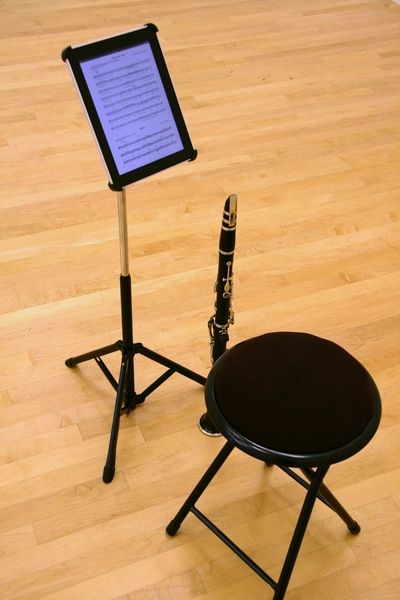
In addition to applications, iPads and tablets can also be used simply to read music. Hundreds of pieces and scores can be stored and viewed perched on a basic metal music stand, with special accessories for turning pages with a button by the performer’s foot.
There are hundreds of other apps out there with similar opportunities for collaboration. Some that I am familiar with include MuseScore for composition, SmartMusic for sight reading and assessment, and iReal Pro for independent or collaborative exposure to jazz.
In school districts and music classrooms that provide these technologies, there is endless opportunity to advance the musical lives of our students, while becoming better musicians ourselves. By exploring these possibilities, we are connecting students to each other and to an ever-evolving technological world.
- Phillips, J. (2015, March 19). Using the iPad in the Music Classroom. National Association for Music Education. Retrieved from https://nafme.org/using-the-ipad-in-the-music-classroom/
- https://tonalenergy.com
- https://www.smartmusic.com/classic/
- https://www.pinterest.com/pin/40110252903363884/
- http://cdm.link/2015/12/modstep-could-change-how-an-ipad-fits-in-your-music-making/
 Tech-ing Music Simply